Most review cycles aren’t caused by bad writing. They’re caused by a brief that never specified what “done” looked like, so the writer guessed, and the reviewer’s job became catching everything the brief should have prevented. Fix the brief and most of the back-and-forth disappears before the first draft is even written.
The brief, not the article, is the actual SEO and editorial deliverable. Treat it that way and review cycles stop being where quality control happens for the first time.
The real problem: unclear briefs create avoidable rework
Most content brief templates built for B2B SaaS teams converge on the same core fields once you strip away formatting differences. A typical thin brief in practice looks like just: topic, target word count, target keyword. That’s enough for a writer to produce something, but not enough to prevent a reviewer from sending it back for missing an angle, wrong tone, no internal links, or a structure that doesn’t match the rest of the site. Every one of those issues could have been prevented at the brief stage. Instead, they surface after a full draft has already been written, which is the most expensive point to catch them.
Most content teams list exactly this pattern among their biggest challenges: content briefs lack clarity, and there are too many review cycles as a direct result. These aren’t two separate problems. The second is caused by the first.
The framework: the Eight-Field Brief
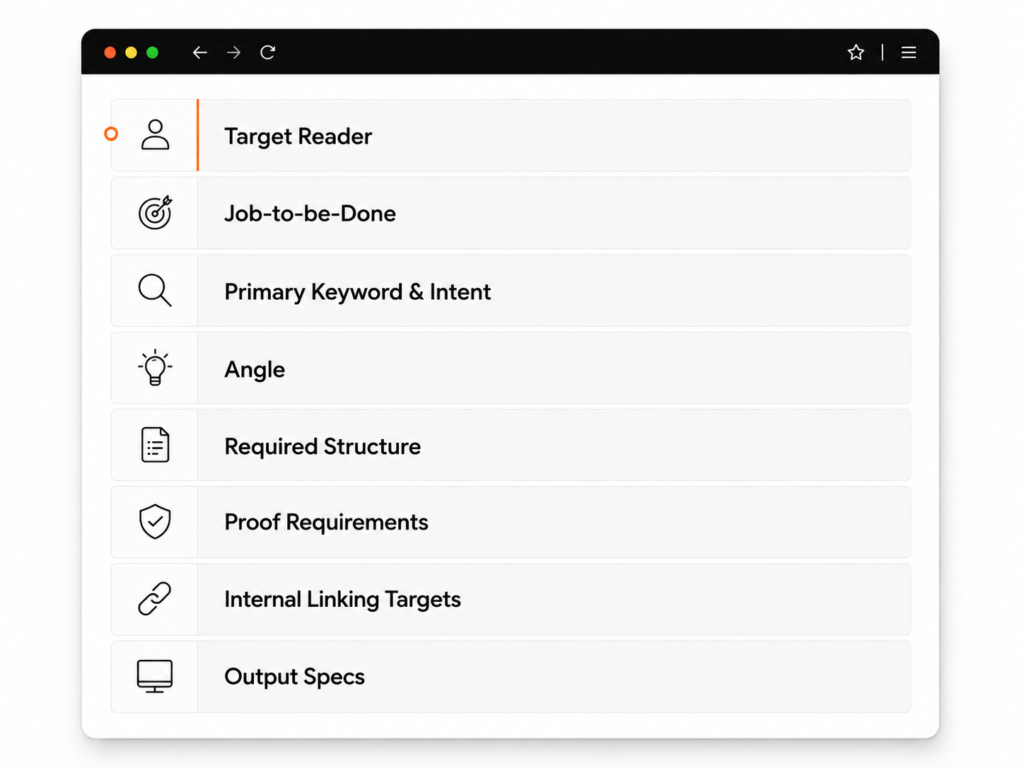
Every brief should include these eight fields, no exceptions:
- Target reader: one sentence, referencing your actual ICP, not “everyone interested in this topic.”
- Job-to-be-done: what problem is this reader trying to solve right now?
- Primary keyword and search intent: the term and whether it’s informational, commercial, or navigational.
- Angle: the specific take, not just the topic. “SOPs for content teams” is a topic. “Why SOPs fail without an owner assigned per step” is an angle.
- Required structure: map to your style guide’s section structure directly in the brief, not as a separate reference document the writer has to look up.
- Proof requirements: which claims need a citation, and where existing internal data or case examples should be used instead of generic statements.
- Internal linking targets: at least one specific URL to link to, decided before writing starts, not searched for during editing.
- Output specs: word count range, due date, and where the draft should be submitted.
The angle field does the most work here. A brief without a defined angle produces generic content that reads like every other article on the topic. That’s exactly what the ICP explicitly ignores.
How it holds up in practice
This adds time to brief creation. Expect 15 to 20 minutes per brief versus 5 for a thin version. That’s the trade: more time upfront, less time in review. Teams that skip straight from “we need an article on X” to assigning a writer will feel this most acutely, since the eight fields require someone to actually think through the angle and proof requirements before the writer starts.
It also won’t fix every review-cycle issue. Voice inconsistency and factual accuracy still need human review regardless of brief quality. What it removes is the avoidable rework: the back-and-forth caused by ambiguity that a clearer brief would have prevented from the start.
Who this is for
Any team with more than one person writing content, especially teams working with freelancers or agencies who don’t have the same context a full-time employee would. Solo creators writing their own content can hold most of this in their head; the brief format matters most when the person writing didn’t design the strategy.
Common mistakes
Teams often fill in the mechanical fields (keyword, word count) but skip the angle field, since it requires more thought, and then wonder why the draft still reads generically. Others create a detailed brief template but don’t enforce its use consistently, so half the team’s briefs are thorough and half are a one-line Slack message. The proof-requirements field gets skipped most often, which is exactly why fact-checking becomes a bottleneck during review.
FAQ
How long should a good brief take to write?
15 to 20 minutes for a familiar topic, longer for something requiring new research.
Should the brief include a full outline?
A structural map (which sections, what goes in each) is enough. A full outline can over-constrain the writer and isn’t necessary if the structure and angle are clear.
Who writes the brief, the content manager or the writer?
Ideally the content manager or strategist, since they have visibility into the angle and how it fits the broader content plan. Writers can draft their own briefs for topics they originated, then have them reviewed.
Does this brief format work for AI-assisted drafting too?
Yes. An AI tool given this level of detail produces a far more usable first draft than one given just a topic and keyword.
What if a freelancer ignores parts of the brief?
Flag it during the calibration period rather than assuming it will self-correct. Specific feedback on which fields were missed is more useful than a general note to “follow the brief more closely.”
Can this template be shortened for smaller pieces?
Yes, for short, low-stakes updates, a condensed 4-field version (reader, angle, keyword, internal link) is often enough.
Next step
Rebuild your next brief using all eight fields, even if it takes longer than usual, and track whether the resulting draft needs fewer revision rounds than your last three. Once the eight fields are standard practice, add one more for AI-extractability. See the content brief field that makes every draft AEO-ready for the exact field to add. And once this brief format is consistent across your team, turn it into a documented process so it survives past whoever built it. See how to turn a one-off process into a documented SOP.
What would you add to this framework?