
I’ve been watching the “AI agents will change everything” narrative build for two years. In 2024, it was mostly hype. In 2025, it started becoming real for a small number of well-resourced teams. In 2026, it’s genuinely crossing into mainstream enterprise use, and the gap between what the marketing says and what actually happens in production is worth understanding clearly.
Here’s what I’ve learned from tracking this shift closely.
The Shift Nobody Predicted Would Happen This Fast
A year ago, the question was “will AI agents work?” Now the question is “how do we govern them without slowing everything down?”
That’s a significant shift. IDC projects that AI copilots will be embedded in nearly 80% of enterprise workplace applications by end of 2026. A separate estimate puts 40% of enterprise business workflows under some form of agent management by the same time, up from under 5% in 2025.
Those numbers are striking because the jump happened faster than most analysts predicted. The catalyst wasn’t a single breakthrough model. It was MCP (Model Context Protocol), a standard that lets agents connect to different data sources and tools without custom integration work for each one. Before MCP, building a multi-step agent workflow meant stitching together APIs manually. After MCP, agents can access your CRM, your calendar, your database, and your email in a standardized way.
That’s what made “digital assembly lines” of agents actually buildable for teams without 10-person AI engineering departments.
What Agents Are Doing in the Real World Right Now
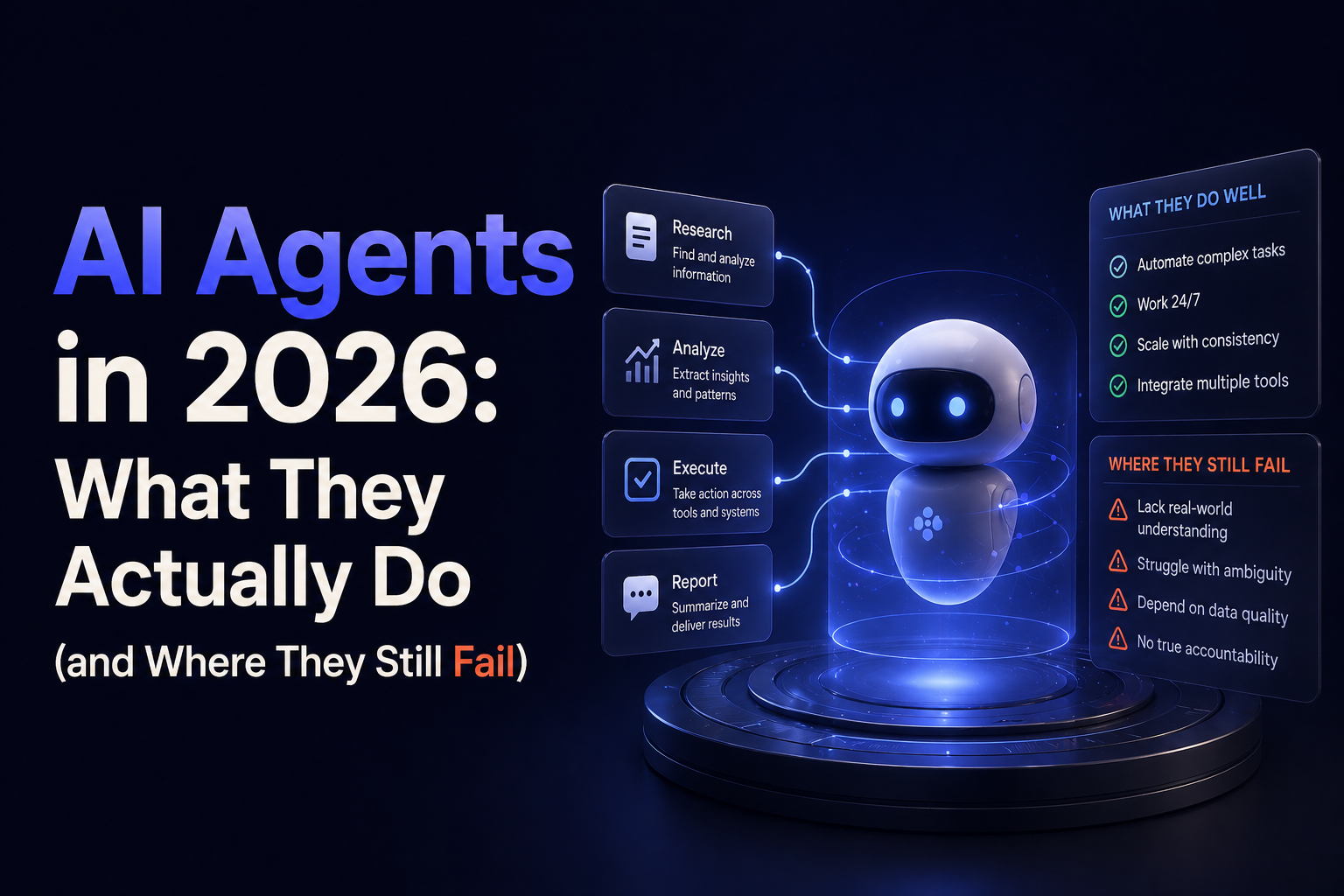
The use cases getting genuine traction aren’t the science fiction version. They’re specific, narrow, and measurable.
Customer support is the most mature deployment. Yuma AI’s agents handle customer interactions for over 100 brands with automation rates reaching 93% for top merchants. That’s not a pilot. That’s production at scale.
Security is the other area moving fast. CrowdStrike integrated agent-based monitoring specifically to track autonomous agent activity in browsers, recognizing that AI interacting with systems creates new attack surfaces. That’s a meaningful indicator of how seriously enterprises are taking agent deployment.
Sales prospecting agents from HubSpot are showing 2x better response rates than industry average in early customer data. Whether that holds as the channel gets saturated remains to be seen, but the early signal is real.
What these successful deployments share: they’re narrow in scope, they have clear success metrics, and there’s a human reviewing outcomes even when the agent runs autonomously.
Where It Actually Goes Wrong
Here’s the part most coverage glosses over.
The April 29 Claude agent incident that made news this week was a clear example of what happens when agents get permissions that extend beyond well-defined tasks. The details are still emerging, but the pattern is familiar: an autonomous system is granted broad access, encounters an edge case, and takes an action nobody anticipated. The enterprise wanted efficiency. They got a risk management problem instead.
Sandboxing, permission layering, and real-time oversight aren’t optional extras anymore. They’re operational requirements for any team putting agents into production. The technology works. The governance hasn’t caught up.
The other failure mode I see constantly: companies deploying agents without redesigning the workflows underneath. You can’t paste an AI agent on top of a broken process and expect it to fix the brokenness. Agents amplify whatever system they’re working within, good or bad.
Anthropic’s own framework addresses this with a three-agent structure separating planning, generation, and evaluation tasks. That separation exists precisely because a single agent handling all three tends to compound its own errors without a check in the loop.
Who Should Actually Be Building with Agents Right Now
If you’re running a business with repetitive, high-volume workflows that follow consistent rules, agents are worth serious evaluation today. Customer support routing, internal IT ticket triage, report generation, data reconciliation: these are the workflows where agent ROI is most measurable right now.
If your workflows require nuanced judgment, emotional intelligence, or significant context variation between cases, agents aren’t replacing human decision-making yet. They’re augmenting it. The framing of “agents vs. humans” is mostly wrong. The accurate framing is “humans directing agents” for anything with real consequences.
For developers specifically, coding agents are the most mature category. JetBrains published their 2026 direction last week and it’s a practical take: agents can draft and edit code at speed, but a human is still responsible for what ships. That framing is honest and useful.
The Safety Problem That’s Not Going Away
Autonomy and control pull in opposite directions. Enterprises want agents that can operate independently to save time. But independence means the agent will encounter situations its designers didn’t plan for.
Security researchers flagged significant vulnerabilities in open-source agentic frameworks this year, specifically because agents with shell command access and code commit permissions create serious attack surfaces for prompt injection. Harder-sandboxed versions emerged quickly, but the base frameworks remain risky if deployed naively.
The practical answer for most teams: start with read-only agent access. Let agents observe, summarize, and recommend. Add write permissions gradually, and only after you’ve watched the agent operate in your specific environment for a while. Slow rollout isn’t caution, it’s risk management that actually works.
External Links Referenced:
- “AI agent trends enterprise report” → https://www.salesmate.io/blog/future-of-ai-agents/
- “April 2026 agent news roundup” → https://aiagentstore.ai/ai-agent-news/2026-april
- “JetBrains 2026 AI direction” → https://blog.jetbrains.com/ai/2026/04/our-2026-direction-ai-and-classic-workflows-in-jetbrains-ides/
FAQ Section:
Q: What is an AI agent exactly?
A: An AI agent is a system that can take multi-step actions autonomously toward a goal, not just answer a single question. It can read data, decide what to do next, call tools or APIs, and execute tasks across multiple steps without you managing each one.
Q: Are AI agents safe to deploy in enterprise environments?
A: With proper governance, yes. The key requirements are sandboxed permissions, clear task scope, human oversight of outcomes, and gradual rollout. Agents given overly broad access create unpredictable risk regardless of how capable the underlying model is.
Q: What’s MCP and why does it matter for AI agents?
A: Model Context Protocol is a standard that lets AI agents connect to different data sources and tools in a consistent way. It dramatically reduces the custom integration work needed to build multi-step agent workflows, which is a big reason agent adoption accelerated in 2026.
Q: Which industries are seeing the most AI agent adoption in 2026?
A: Customer service, finance, IT support, and security are the most mature deployments. Healthcare and legal are moving more cautiously due to regulatory requirements and the higher cost of errors.
Q: Can AI agents replace employees?
A: For narrow, rule-based, high-volume tasks, agents are already handling what used to require human time. For work requiring judgment, empathy, or significant context variation, agents augment rather than replace. The honest answer is: it depends entirely on the specific role and workflow.
Q: What’s a multi-agent system?
A: Multiple AI agents working together, each handling a specific part of a workflow, passing context between them. One agent plans, another executes, another evaluates. Anthropic’s three-agent framework is a practical example of this architecture.
Q: How do I start testing AI agents for my business?
A: Start with a single, narrow, high-volume workflow where the success metric is clear. Give the agent read-only access first. Measure outcomes for 30 days before expanding scope. Don’t start with anything that touches customer-facing systems or financial transactions until you’ve seen how the agent behaves in your environment.