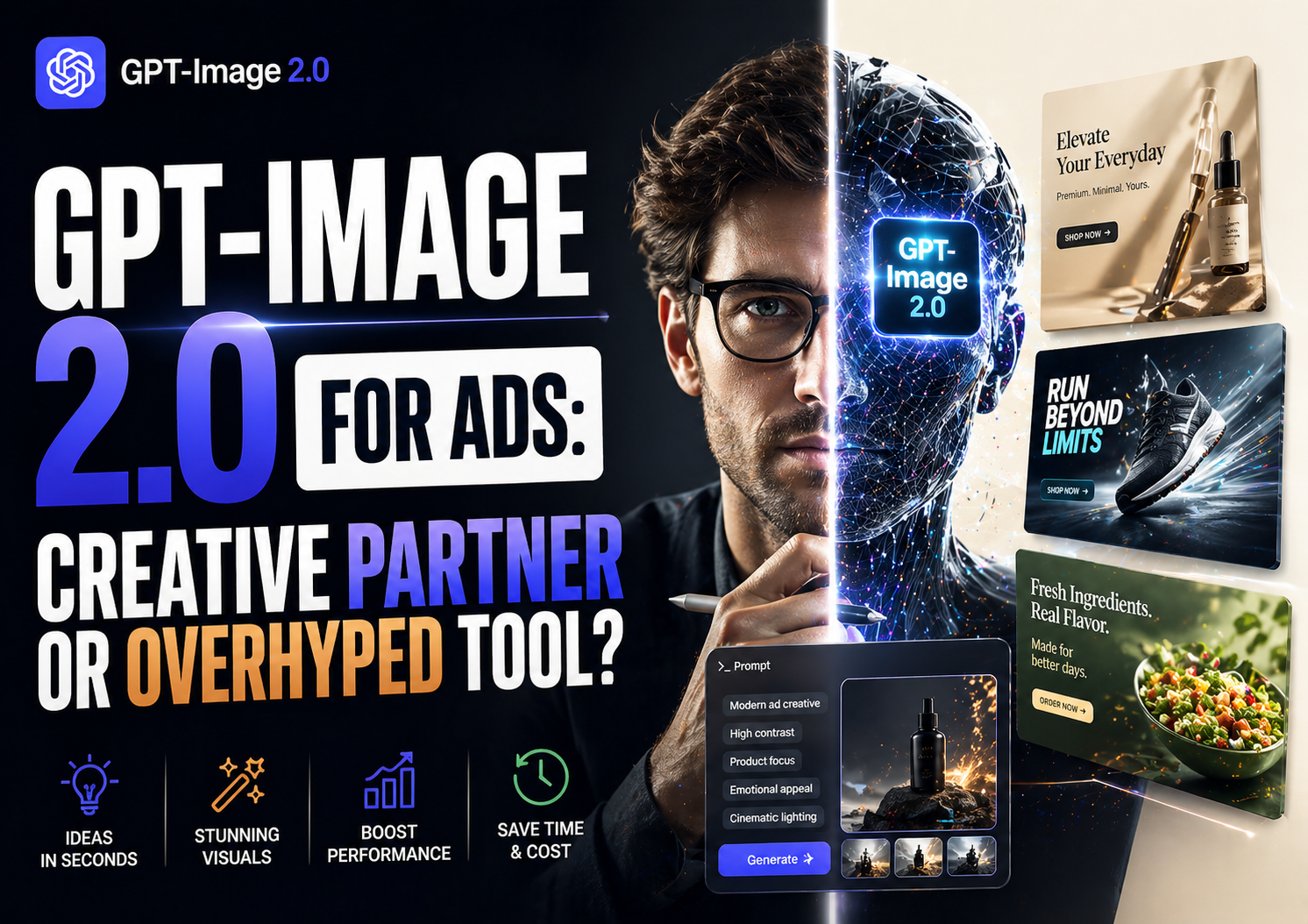

I’ve seen a lot of AI image tools get called “game changers.” Most aren’t. But the recent Leonardo.Ai test of GPT-Image 2.0 on actual advertising briefs caught my attention not because of the hype, but because of one specific detail buried in the report.
The model added a TikTok sticker to a Gen Z lip balm ad. Nobody asked it to.
That’s either impressive creative instinct or a liability nightmare, depending on who you ask.
The Problem With AI in Ad Creative (Until Now)
Most AI image tools are great at making things look good. They’re terrible at making things mean something.
Advertising isn’t about pretty pictures. It’s about the right visual, in the right context, for the right audience on the right platform. A stunning product shot that ignores format, audience psychology, and placement context is useless to a real creative director.
That’s the gap GPT-Image 2.0 is apparently trying to close. According to Dwayne Koh who has worked on campaigns for Adidas Originals, Levi’s, and Jordan the model was tested using plain, unprompted language. No elaborate prompt engineering. Just brief descriptions, like an actual client handoff.
The results were described as “creatively coherent, not just technically accurate.” That framing is worth sitting with.
What the Leonardo.Ai Test Actually Found
Koh’s test is the most honest public evaluation of GPT-Image 2.0 I’ve seen from someone with real advertising credentials. A few things stood out.
First, the model interpreted briefs contextually, not literally. Most image generators translate prompts word-for-word. GPT-Image 2.0 apparently read a Gen Z lip balm brief and understood the cultural context well enough to add platform-native elements (the TikTok sticker) without being told.
Second, the model seems to understand audience, not just aesthetics. That’s a harder problem than resolution or style fidelity, and it’s where most AI tools fall flat.
Third and this is Koh’s bigger argument he thinks AI is shifting the creative process itself. Instead of “here’s the concept, now render it,” the workflow becomes “here’s the brief, what do you see?” AI becomes a thought partner in the ideation phase, not just a production tool at the end.
I find this genuinely interesting. It’s also genuinely untested at scale.
What I’d Want to Know Before Betting My Campaign On It
The Leonardo.Ai report is promising, but it’s one creative director testing one model on a handful of briefs. That’s not a workflow validation.
Here’s what I’d want to know before integrating GPT-Image 2.0 into real ad production:
Brand consistency. Can it hold a brand’s visual language across a campaign, or does every image feel like a creative reset? For one-off hero images, maybe fine. For a 12-asset campaign rollout, consistency matters enormously.
Legal exposure. The TikTok sticker example is charming in a test context. In production, anything platform-branded in generated creative is a legal conversation. Who owns that output? Does OpenAI’s usage policy cover commercial advertising at scale?
Revision handling. Real ad work involves rounds of feedback. “Make it warmer,” “shift the product left,” “the client wants the logo bigger.” How does GPT-Image 2.0 handle iterative direction without drifting from the original concept?
These aren’t dealbreakers they’re due diligence questions anyone building a real workflow should be asking.
Who This Actually Makes Sense For Right Now
Small agencies and freelancers doing fast-turnaround social content. The speed and contextual coherence could cut concepting time significantly without the budget for a full design team.
In-house marketing teams running high-volume content at scale product variations, regional campaign adaptations, A/B test assets. GPT-Image 2.0 seems strong at “many variations of a similar thing.”
Creative directors using it as an ideation tool, not a final production tool. Koh’s framing AI as a thought partner is probably the right mental model for 2026. Render later. Think together first.
Probably not yet: Premium brand campaigns where every pixel is a brand decision. The “spontaneous creative choices” that make GPT-Image 2.0 interesting in a test environment are exactly what makes it risky for clients with strict brand guidelines.
Common Mistakes With AI Ad Creative
Treating generated images as final assets without a human creative review. AI doesn’t understand brand risk, legal constraints, or cultural context the way a trained creative does. Use it to go faster, not to skip steps.
Prompting it like a search engine. The more context you give audience, platform, tone, campaign goal the more the model has to work with. Vague prompts get generic results, even from good models.
Ignoring the revision workflow. Most teams adopt AI tools for generation, then revert to manual tools for edits. Build the full loop before committing to a tool, not just the first step.
External Links Referenced:
- “Leonardo.Ai GPT-Image 2.0 test write-up” → https://futuretools.io/news
- “OpenAI GPT-Image 2.0 documentation” → https://platform.openai.com/docs
FAQ Section:
Q: What is GPT-Image 2.0?
A: OpenAI’s second-generation image model, designed for higher contextual coherence and creative accuracy. It interprets briefs more holistically than most image generators, not just prompt keywords.
Q: Is GPT-Image 2.0 good for advertising?
A: Promising for concepting, ideation, and high-volume social content. Still needs human creative review before anything goes live. Not ready to replace senior creative directors on brand campaigns.
Q: How does GPT-Image 2.0 compare to Midjourney or DALL-E 3?
A: GPT-Image 2.0 appears stronger on contextual brief interpretation. Midjourney still has an edge on pure aesthetic quality for many styles. DALL-E 3 was the predecessor V2 is a significant step up.
Q: Can I use GPT-Image 2.0 for commercial advertising?
A: Check OpenAI’s current commercial usage terms carefully, especially for assets with platform-branded elements or celebrity likenesses. Policies update frequently.
Q: What’s the Leonardo.Ai connection?
A: Leonardo.Ai is an AI creative platform that tested GPT-Image 2.0 internally. Their head of creative, Dwayne Koh, published findings from using it on real ad briefs one of the more credible real-world evaluations available.
Q: Will AI replace ad creative teams?
A: Not in the near term. It changes what the job looks like more brief interpretation and creative direction, less manual production. The highest-value creative thinking stays human.
Q: What’s the biggest risk of using AI image tools in advertising?
A: Brand inconsistency across a campaign and legal exposure from AI-generated elements (platform logos, likenesses, trademarks). Always run a legal review before publishing at scale.
Q: How do I get better results from GPT-Image 2.0?
A: Give it full context: audience, platform, tone, campaign goal. Treat it like briefing a junior creative, not querying a search engine. Specificity beats cleverness in prompt writing.