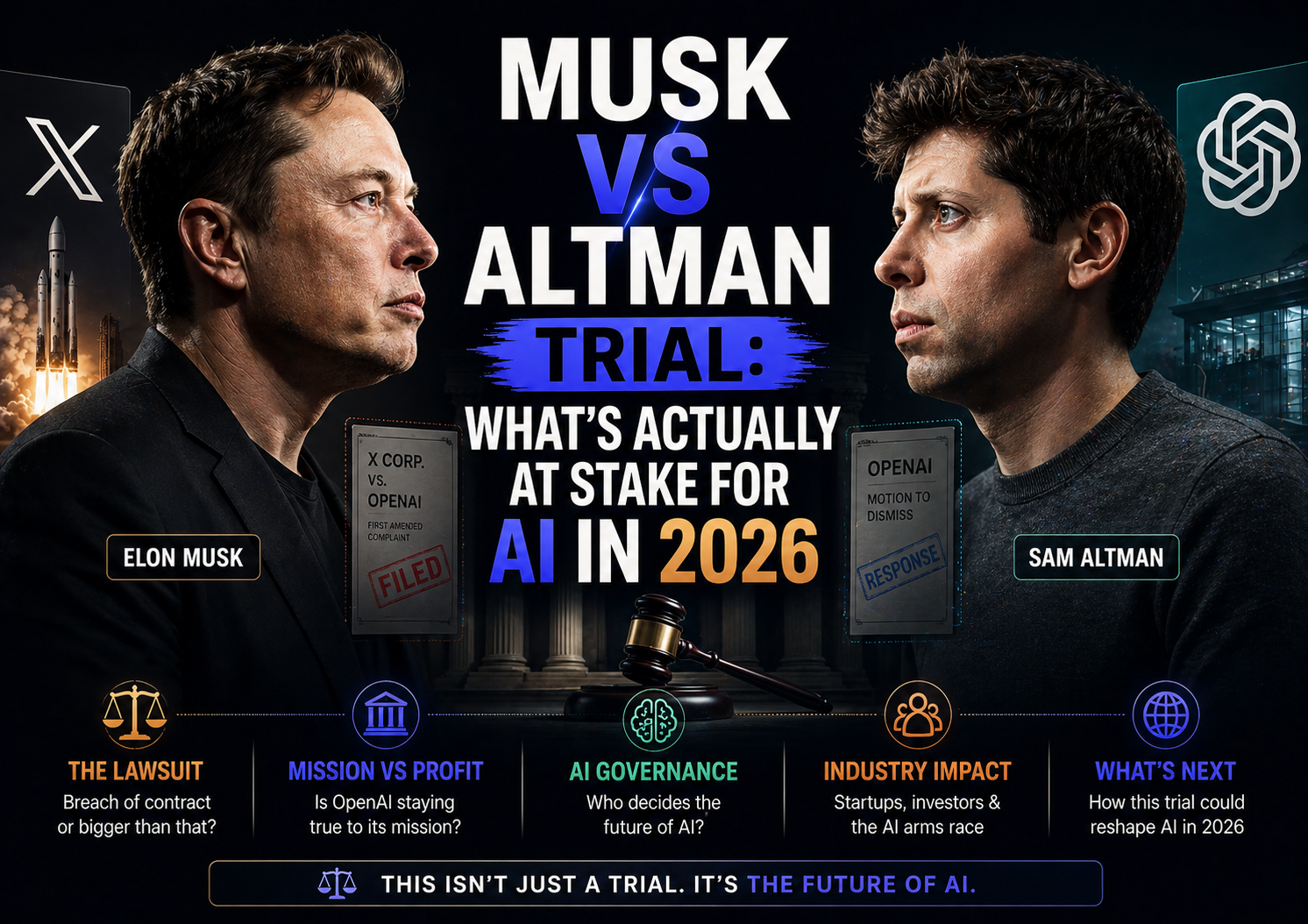

I’ve covered a lot of AI drama over the years. Acquisitions, model launches, jailbreaks, benchmark wars. But nothing has the sheer storytelling density of what kicked off in an Oakland federal courtroom on April 28, 2026: Elon Musk testifying against Sam Altman in a case that could literally restructure one of the most valuable AI companies on the planet.
This isn’t just a tech beef. The outcome could affect every major AI lab, every AI investor, and every developer building on OpenAI’s API. Here’s what’s actually at stake.
The Core Accusation
Musk cofounded OpenAI in 2015 alongside Altman and others as a nonprofit with a mission to develop AI for humanity’s benefit. He contributed more than $44 million in early funding. Then he left the board in 2018 after a power struggle. And then watched from the outside as OpenAI launched a for-profit subsidiary in 2019, partnered with Microsoft for billions in investment, and grew to a company now worth $852 billion with nearly 1 billion weekly active users.
Musk’s lawyers are arguing that Altman and Greg Brockman deceived him. That they promised nonprofit status while secretly planning a for-profit pivot. OpenAI’s response is blunt: Musk knew the for-profit structure was coming, was part of those discussions, and only filed suit after failing to install himself as CEO. His own 2020 post on X calling OpenAI “essentially captured by Microsoft” is being used as evidence he knew about the Microsoft relationship years before suing.
Musk is seeking up to $134 billion in damages from OpenAI and Microsoft, removal of Altman and Brockman from leadership, and restoration of OpenAI as a pure nonprofit.
Why This Matters Beyond the Drama
The stakes here are structural. OpenAI is reportedly planning an IPO as soon as late 2026. If Musk wins and the court orders the for-profit conversion unwound, that IPO doesn’t happen. The entire investment structure, including Microsoft’s multi-billion dollar stake, gets called into question.
It would also set a legal precedent for how nonprofit-to-for-profit conversions in tech get treated going forward. There are other AI organizations that started with nonprofit mandates and have since shifted toward commercial structures. A ruling against OpenAI creates legal exposure far beyond this one case.
For developers and enterprises building on OpenAI’s APIs: a destabilized OpenAI leadership or forced structural change creates real platform risk. That’s worth thinking about regardless of who you’re rooting for in the courtroom.
What I Think Is Actually Going On
I’ve been following this since the lawsuit was filed and my honest read is: both sides have legitimate points, which is what makes this genuinely hard to predict.
Musk has documented evidence that he was told the nonprofit mission was non-negotiable, even as internal discussions about a for-profit were already underway. OpenAI has documented evidence that Musk himself proposed merging OpenAI into Tesla, which is about as for-profit as it gets. The court has already found that in 2017, Musk threatened to stop funding while Altman and Brockman told him they were committed to the nonprofit structure.
Whether that constitutes fraud or just messy startup politics is what nine jurors are now deciding.
What I’m watching most closely is Satya Nadella’s testimony. Microsoft is a named defendant. If OpenAI’s relationship with Microsoft gets forensically examined under oath, the public is going to learn a lot about how that $10+ billion partnership was actually structured.
The Witnesses You Should Track
Musk has already testified and will face cross-examination. Altman is expected on the stand, along with Brockman, Nadella, former OpenAI CTO Mira Murati, and former chief scientist Ilya Sutskever. That last name is interesting. Sutskever left OpenAI in 2024 and has his own AI company now. His testimony could go in unpredictable directions.
Expert witnesses include Stuart Russell from UC Berkeley, one of the most respected AI safety researchers alive, who is testifying for Musk. Having Russell frame the nonprofit mission as genuinely important, not just a legal technicality, is a smart strategic call.
What Developers Should Do Right Now
If you’re running production workloads on OpenAI’s API, this is a good time to audit your dependency. Not because OpenAI is going away, but because prolonged legal uncertainty can slow product decisions, spook investors, and delay model releases.
Diversifying across Claude, Gemini, and open-weight models where possible isn’t pessimism. It’s standard platform risk management that this trial makes more visible.
FAQ Section:
Q: What is the Musk vs Altman trial about?
A: Musk is suing OpenAI and its leadership, claiming he was deceived when the company converted from a nonprofit to a for-profit structure. He’s seeking up to $134 billion in damages and wants Altman removed from leadership.
Q: Could OpenAI actually be forced to become a nonprofit again?
A: Theoretically yes, but most legal experts think it’s unlikely. The court would have to find both that Musk was defrauded and that he had legal standing to demand the conversion be unwound. Both are contested claims.
Q: How does this affect OpenAI’s planned IPO?
A: Significantly. A ruling against OpenAI could delay or derail the IPO entirely. Even without a ruling, prolonged legal uncertainty makes investor confidence harder to maintain in the lead-up to a public listing.
Q: Is Microsoft involved in the trial?
A: Yes. Microsoft is named as a defendant for allegedly aiding OpenAI’s for-profit conversion. Microsoft CEO Satya Nadella is expected to testify.
Q: What happens if Musk wins?
A: He’s asking for OpenAI’s for-profit gains to be disgorged, Altman and Brockman to be removed, and the company to revert to nonprofit governance. Practically, this would be enormously disruptive to the entire AI industry.
Q: What is OpenAI’s defense?
A: That Musk knew about and participated in discussions about the for-profit structure, that he even proposed merging OpenAI into Tesla, and that he only sued after losing the internal power struggle for control of the company.
Q: Should developers be worried about building on OpenAI’s API?
A: It’s worth watching closely. The trial probably won’t result in an overnight disruption, but prolonged uncertainty is a reason to evaluate platform diversification as standard risk management.
Q: How long is the trial expected to last?
A: Estimates vary, but it’s likely to run several weeks given the number of witnesses and complexity of the claims.