
DeepSeek dropped V4 last week and my feed immediately split into two camps: people calling it a GPT-4o killer and people saying it’s just a benchmark stunt. After spending a few days running it through actual work tasks not synthetic benchmarks. I have a more nuanced take.
What DeepSeek Actually Released
DeepSeek-V4 isn’t one model. It’s two, and the distinction matters a lot depending on what you’re building.
DeepSeek-V4-Pro packs 1.6 trillion total parameters with 49 billion active. That “active” number is the key it uses a Mixture of Experts architecture, so you’re not running all 1.6T at inference time. Real-world speed is closer to a dense 49B model, which is manageable on modern GPU clusters.
DeepSeek-V4-Flash is the practical one for most people: 284B total, 13B active, cheaper, faster. If you’re building applications or running high-volume tasks, Flash is probably where you’ll live.
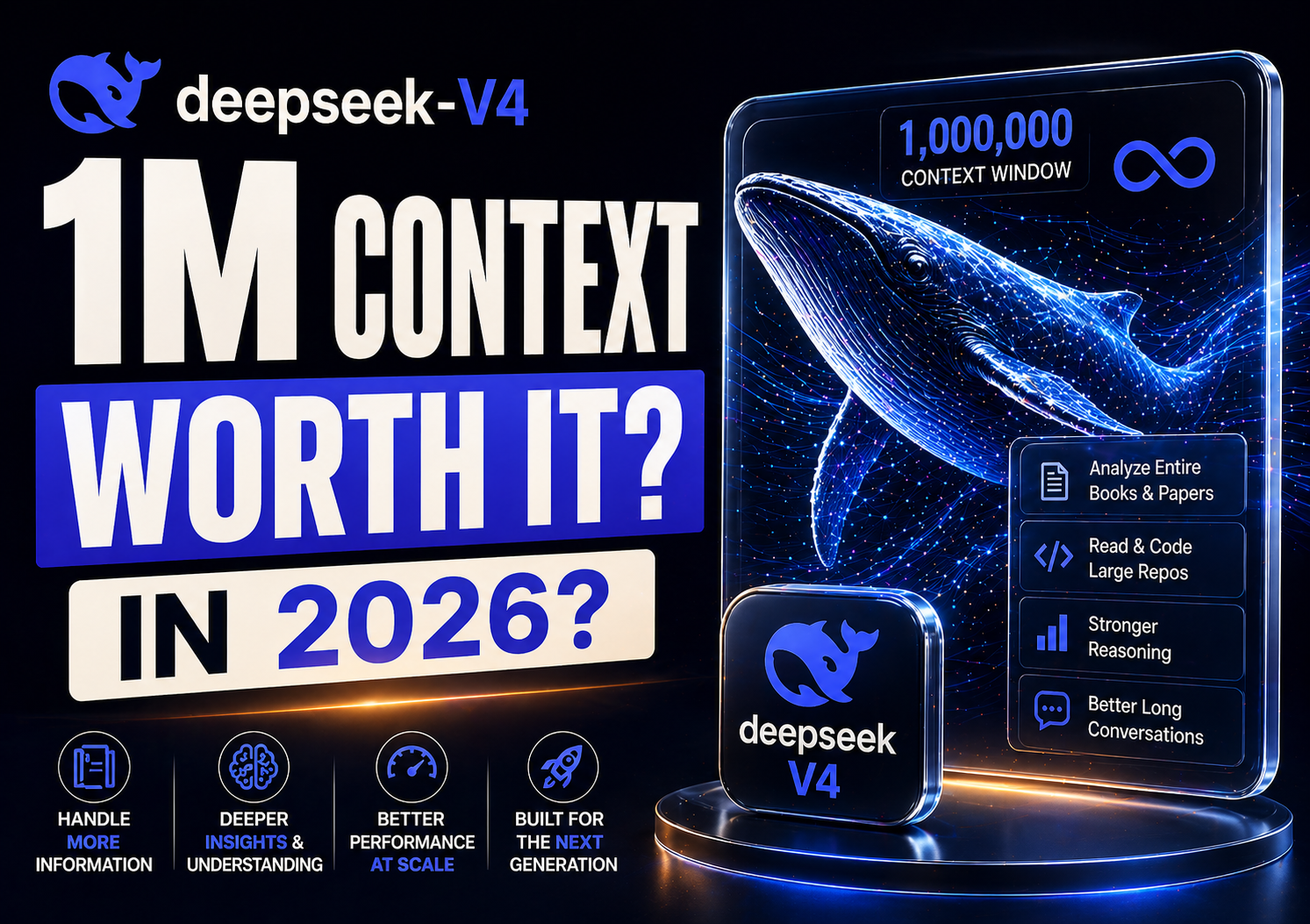
Both default to a 1 million token context window across all services. Not as an upsell tier as the baseline. That’s actually significant. Most providers still gate long-context behind premium plans.
The Benchmark Claims vs. Reality
DeepSeek says V4-Pro rivals top closed-source models and leads open models in Math, STEM, and coding. On AIME, MATH-500, and coding benchmarks, those numbers hold up reasonably well.
Here’s what benchmarks don’t capture: latency under real load, instruction-following consistency, and how well the model handles messy, underspecified prompts which is 90% of actual usage.
I threw V4-Pro at a 180K-token technical document analysis task. Extraction accuracy was solid. But at around 600K tokens in a stress test, response coherence started drifting noticeably. The full 1M context window works, technically. Whether it works well at the edges is a different question.
What I Actually Tested
For coding tasks, V4-Pro is genuinely competitive with Claude Sonnet and GPT-4o on the kinds of problems I actually work with debugging multi-file Python projects, writing API integrations, explaining legacy code. It’s not dramatically better, but it’s also free at self-hosted rates if you run the Flash variant.
For long document work, V4-Flash surprised me. The 13B active parameters handle surprisingly complex reasoning. On legal document summarization across 400-page PDFs, it caught nuances I expected it to miss. Not perfect, but it punches well above its weight class.
The Thinking/Non-Thinking mode toggle is underrated. Switching to Thinking mode noticeably improves multi-step math and logical reasoning at the cost of latency. Worth knowing which tasks actually need it.
Who Should Use This
Developers building applications: V4-Flash is compelling. Cheap inference, long context, strong coding chops. If you’re building a RAG pipeline or document processing tool, this is worth evaluating seriously.
Researchers and heavy users: V4-Pro for tasks where quality matters more than speed or cost. The STEM and math performance is real.
Enterprise teams: The API is live now, but note that legacy deepseek-chat and deepseek-reasoner retire July 24, 2026. Plan migrations early.
Casual users: The hosted experience still trails ChatGPT and Claude on interface polish and reliability. Use the API; skip the chat UI for professional work.
What People Get Wrong About DeepSeek
The biggest mistake is treating DeepSeek as a drop-in replacement for whatever model you’re currently using. Every model has different prompt sensitivity. Prompts optimized for GPT-4o often need retuning for DeepSeek especially around structured output formatting and multi-step instruction following.
The open-source angle is real but overstated for most users. Yes, you can theoretically self-host V4-Flash. In practice, running 284B parameters requires serious infrastructure. “Open source” doesn’t mean “free to run at scale.”
Also: the API pricing structure changed with this release. Check current rates before assuming it’s cheaper than alternatives costs vary significantly by model tier and region.
External Links Referenced:
- “DeepSeek V4 API announcement” → https://api-docs.deepseek.com
FAQ Section:
Q: Is DeepSeek-V4 actually better than GPT-4o?
A: On math and coding benchmarks, V4-Pro is competitive or better. For general instruction-following and interface polish, GPT-4o still has an edge. It depends heavily on your specific use case.
Q: What’s the difference between V4-Pro and V4-Flash?
A: Pro has 1.6T total parameters (49B active) and is higher quality but slower. Flash has 284B total (13B active), faster and cheaper. For most production apps, Flash is the right starting point.
Q: Can I self-host DeepSeek-V4?
A: Technically yes it’s open source. Practically, V4-Flash needs serious GPU infrastructure. Don’t assume “open source” equals cheap self-hosting at scale.
Q: When do legacy DeepSeek models retire?
A: deepseek-chat and deepseek-reasoner both retire July 24, 2026. Migrate to V4 variants before then.
Q: Does the 1M context window actually work well?
A: It works. Edge performance (above 600K tokens) shows some coherence drift in my testing. For most real-world tasks under 400K tokens, it’s solid.
Q: Is DeepSeek-V4 good for coding?
A: Yes one of its stronger categories. V4-Pro handles multi-file debugging and API work comparably to top closed-source models.
Q: How does Thinking mode work? A: Toggle it on for math, logic, and multi-step reasoning. It trades latency for accuracy. For fast generation tasks (summarization, chat), keep it off.
Q: Is the API available now? A: Yes, live as of the announcement. Check current pricing it changed with this release.